Design and Technology
At St Andrew's CE VA Primary School, our Design and Technology Curriculum provides opportunities for the children to think of themselves as, and become, designers and producers of purposeful products that will be used in real-life contexts. We encourage the children to think and intervene creatively to solve problems both as individuals and as members of a team. The children consider their own and others’ needs, wants and values. The children are also given opportunities to reflect upon and evaluate past and present design technology, its uses and effectiveness. We allow pupils to flourish as collaborators, enterprisers, risk-takers and problem solvers whilst developing their practical designing and making ability.
Within the Design and Technology Progression of Skills Map, our progressive objectives identify what pupils should know by the end of each year group and link to prior learning. These enable teachers to identify and plug gaps in pupils’ knowledge and skills.
Within Design and Technology, pupils will develop a deep understanding of key concepts and second order concepts. These key concepts have been carefully considered and identified as the core knowledge and skills, required to successfully achieve in Design and Technology.
The Key concepts are revisited and developed as the pupils move through the school to ensure the knowledge and skills are firmly embedded within the long-term memory. These key concepts compliment work carried out across the school in line with our key curriculum drivers. The expectation is that, by the end of primary school, children will know and understand these key concepts and to give them a solid foundation to enter the Design and Technology curriculum at KS3.
In addition to first order concepts, subject specific second order concepts have been identified. These can be used across all aspects of a subject to organise the substantive knowledge and skills taught.
The Design and Technology curriculum is structured into six key concepts:
- Appraise and Analyse
- Technical Knowledge
- Practise
- Generate Ideas and Design
- Develop and make
- Evaluate
Second order concepts:
These second order concepts will be explored and developed throughout the D&T curriculum as pupils move through the school. They can be used across all aspects of a subject to organise the substantive knowledge taught.
– Responsibility: (working safely, how design can solve problems, choosing the right materials, responsibilities to customers to ensure quality / reliable products, healthy eating, quality ingredients)
– Similarity and difference: (making comparisons, noting differences and drawing conclusions)
– Cause and consequence: (identifying how things work, how an action can cause change/movement)
– Significance: (significant designers and designs, real world examples of effective and successful products)
– Written and oral expression: (Using terminology, evaluating, creating accurate designs, labelling and annotating, explaining processes, presenting)
By the end of EYFS, pupils will:
• be able to explore and choose a range of materials to create and make things
• be able to investigate how things work
• draw, build and make things which fulfil a function
By the end of Key Stage 1, pupils will:
• learn the knowledge and skills needed to design and make products for a range of relevant contexts
• be able to design and test products that are purposeful and appealing
• select tools and materials which are most suitable to make their products from
• evaluate their products against existing products and design criteria
• develop the technical knowledge needed to build structures which are stronger and more stable and be able to use a range of mechanisms
• develop an understanding of where food comes from and how to use the basic principles of a healthy diet to make their own simple dishes
By the end of Key Stage 2, pupils will:
• develop further knowledge and skills to enable them to design and make purposeful and quality products in different contexts
• be able to research how existing products work and use this to develop designs and products to meet a design brief
• be able to produce more detailed, annotated designs and to test and refine their ideas
• be able to select and use a wider range of tools and materials according to their function and properties
• develop the technical knowledge required to make their products work effectively
• be able to evaluate the effectiveness and quality of their products and use this to improve their work
• develop an understanding of a healthy and varied diet and be able to prepare and cook a range of dishes.
Any child working below their age-related expectation will receive a tailored curriculum with personalised objectives taken from the Curriculum Assessment tools. This will enable all children to build the skills and knowledge needed to bridge the gap between themselves and their peers, enabling them to reach their full potential.
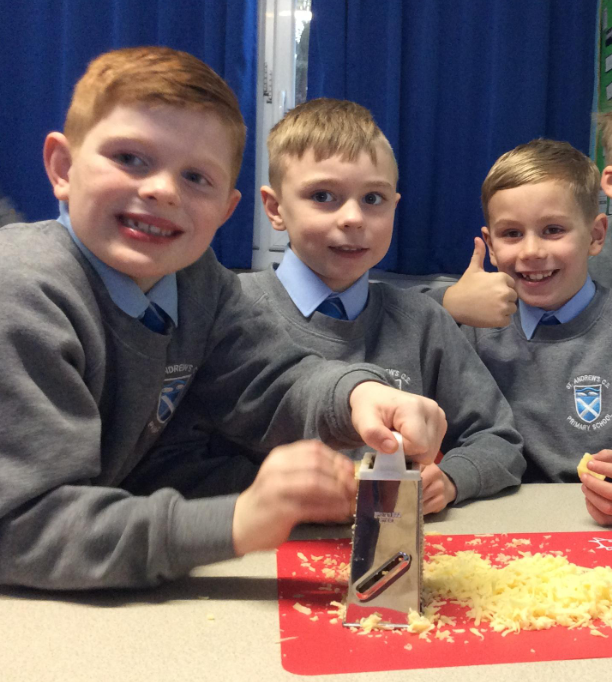
Making seasonal tarts in Year 3

Implementation
Through a variety of creative and practical activities, we teach the knowledge, understanding and skills needed to engage in an iterative process of designing and making. Each class completes at least three projects a year. Each project has strong links with the class’s topic work and is designed to help the pupil’s learning across the curriculum with particularly strong links with Science, Maths, Computing and Art.
Across the primary phase, we ensure the pupils have a deep understanding of Design, Structures, Mechanisms, Electrical Control and the use of a Range of Materials (including food).
Each project is designed to cover the two main elements of D&T:
-
learning about the design and made world, and
-
how things work and the design and make of functional products.
We believe D&T is a crucial part of school life and learning and it is for this reason that as a school we are highly dedicated to the teaching and delivery of high-quality Design and Technology curriculum; through well planned and resourced projects and experiences.
Impact
For children in Key stage 1 and Key stage 2. we assess work in D&T whilst observing them during lessons and at the end of termly projects. Teachers record the progress made by children against the learning objectives for their lessons. At the end of a unit of work teachers make a summary judgement about the work of each pupil in relation to the National Curriculum levels of attainment.
Formative assessments are also carried out by teachers after each lesson which will allow them to inform future planning. Additionally, summative assessments are carried out by using an internal assessment tool. As a result of these assessment tools, pupils’ misconceptions or gaps in subject knowledge, skills, behaviours and attitudes are addressed and additional teaching and support is provided.
In EYFS, staff professional judgements are valued. Assessments are formative so that they quickly make a difference to children’s learning. They inform the provision of activities and experiences which develop children’s skills and knowledge as well as giving opportunity for further practise. Children in the Early Years Foundation Stage are assessed within Expressive Arts and Design and their progress is tracked termly using the Development Matters Framework. We record WOW moments on Class Dojo. Age related expectation levels are reported to parents at the end of the reception year.
Our Subject Leader will monitor the effectiveness of the Design and Technology curriculum through carrying out regular subject evaluations. These evaluations are quality assured by the Curriculum Lead, Senior Leadership and Governors.
The effectiveness of Design and Technology is also monitored through pupil and parental voice throughout the course of the year.